Just 15 minutes from the heart of Old Quebec lies one of Canada's best-kept secrets : Île d'Orléans. Often overlooked by travelers who fly in and out of Quebec City, this 67-km heritage island is home to six French colonial villages, 60+ local food producers, and some of the most beautiful landscapes in the province. This guide walks you through the perfect one-day visit — and explains why you might want to extend it into an overnight stay.
Why Île d'Orléans deserves a day (or more)
Île d'Orléans was among the first places settled by the French in New France. Today, it is a designated heritage site with six villages, each retaining its 17th and 18th-century character : stone farmhouses, narrow winding roads, and churches older than the United States. The island is also Quebec's pantry : apples, strawberries, maple syrup, artisan cheese, ice cider, and wine are all produced here.
Crossing the bridge from mainland Quebec takes 5 minutes, but psychologically, you enter a completely different rhythm : slower, rural, soaked in history. Most Quebec City visitors miss this entirely. They're wrong.
When to visit : season by season
May-June : Apple blossoms & first cideries open
The orchards are in bloom. Producers start reopening after winter. Cool evenings but bright days. Best for photographers and quiet walks.
July-August : Peak season, highest energy
Everything is open. Outdoor markets, festivals, strawberry fields in self-pick. Crowds are manageable compared to Montmorency Falls or Old Quebec. Book accommodation in advance.
September-October : Fall colours & apple harvest
The most photogenic season. Apple-picking is the main attraction, with fall colours rivaling Vermont's. October has ice-cider production in full swing. Cooler but sunny.
November-April : Winter charm (plus quiet)
Many producers close, but restaurants like Moulin de Saint-Laurent stay open. Snow-covered villages are a visual treat. Best for couples seeking quiet.
The ideal 1-day itinerary
- 9 :30 AM — Cross the bridge, start at Sainte-Pétronille. Begin at the westernmost tip of the island. Park and walk down to the riverfront for the most famous view : Old Quebec and the Château Frontenac across the St. Lawrence. Visit Chocolaterie de l'Île d'Orléans — homemade ice cream (even in winter), chocolates, and a tea room overlooking the river.
- 11 :00 AM — Drive east to Saint-Laurent. The village of Saint-Laurent is recognized by the Association of Most Beautiful Villages of Quebec. Neoclassical church from 1860, wooden maisons canadiennes, and scenic river views. Stop at the Parc maritime de Saint-Laurent for a quick walk if weather allows.
- 12 :30 PM — Lunch at the Moulin de Saint-Laurent. This 1728 mill is still in operation — part restaurant, part historic site. The terrace sits next to a small waterfall; the dining room has stone walls and wooden beams. Local products on every plate. Expect around $25-40 for a three-course lunch.
- 2 :00 PM — Cideries & vineyards loop. The heart of the island's producer scene. Hit these :
- Cidrerie Verger Bilodeau — Pioneer cider-maker with apple orchard tours.
- Domaine Steinbach — Ice ciders and charcuterie, with the best orchard view.
- Cassis Monna & Filles — Black-currant liqueurs and crèmes. Unique in North America.
- Vignoble Sainte-Pétronille — Wines made from cold-climate grapes, with a tasting room overlooking Quebec City.
- 4 :30 PM — Fromages de l'Isle d'Orléans. North America's oldest cheese recipe (pre-1635), revived. Stop for tasting and buy some to take home. Small but unforgettable.
- 5 :30 PM — Option A : Drive back to Quebec City for dinner. OR : Option B : Stay the night. (Keep reading.)
Why you should stay overnight instead of driving back
Most visitors cram Île d'Orléans into a day trip. It's a mistake. Here's why :
- You can only taste 3 cideries sober. With a designated driver or staying overnight, you properly enjoy the island's distilled treasures.
- Sunset over the river is the best visual moment of the day. You miss it if you leave at 5 pm.
- Island evenings are incredibly quiet. Zero light pollution, occasionally northern lights in autumn.
- Local restaurants in Saint-Laurent and Sainte-Pétronille shine at dinner. Moulin de Saint-Laurent is even better at night.
- Next morning — coffee on a country porch beats coffee in a city hotel. Always.
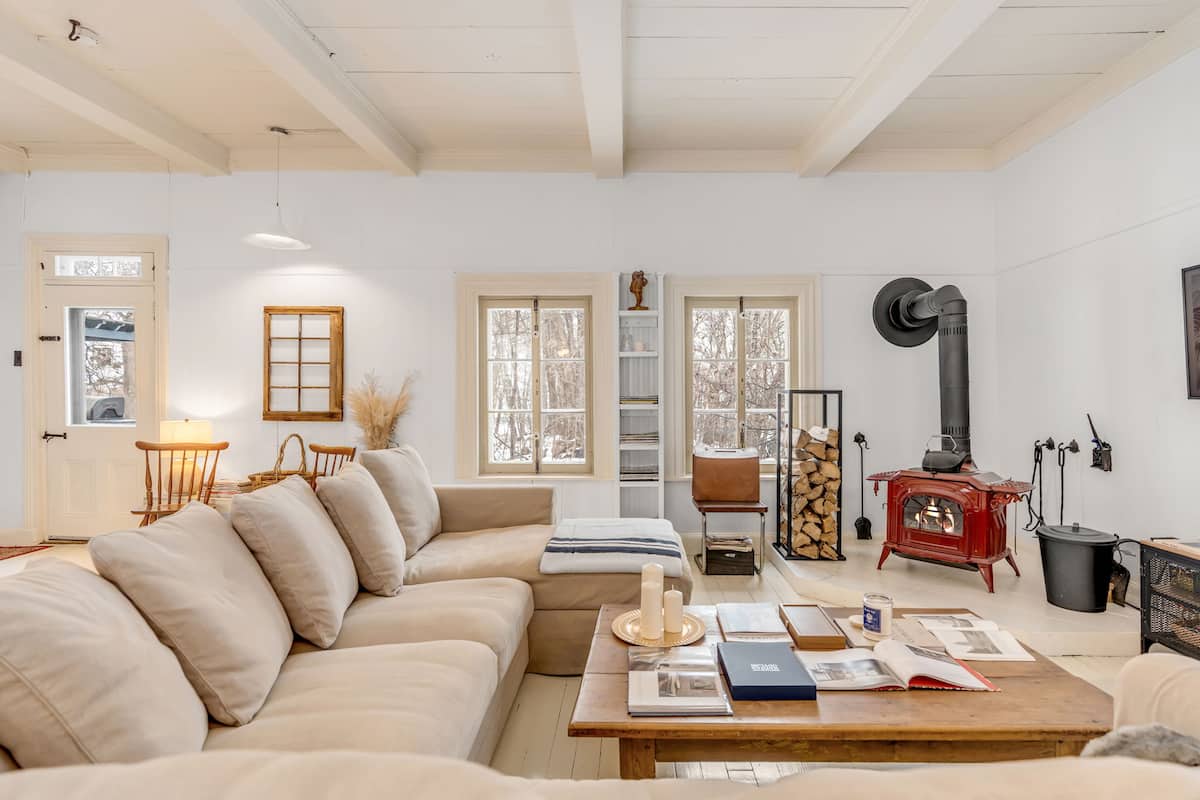
La Petite École de l'Île d'Orléans — A 1839 schoolhouse restored and converted into a vacation rental, on the main scenic road in Saint-Laurent. Sleeps 6, 2 bedrooms, 1.5 bathrooms, wood stove, full kitchen. Walking distance from the Moulin de Saint-Laurent and minutes from most producers on the island. Rated 4.85/5 on Airbnb (60+ reviews), Superhost status. The kind of place that becomes the trip's best memory, not just the accommodation.
Practical tips for the day trip
Transportation : A car is essential. There is no public transit on the island. Rentals are available at Quebec City airport or from downtown. Distances are short but the 67-km loop road takes a full day to properly explore.
Parking : Free at all producers and most public spots. No paid lots like in Old Quebec.
Food & drink stops : Plan at least two tasting stops (one cider, one cheese or wine). Do not drive if you plan to taste. Either bring a designated driver or stay overnight (recommended).
Best photo spots : Sainte-Pétronille river view (morning light), Saint-Laurent wooden houses (afternoon), Saint-Jean view of river and mountains (sunset).
Language : Île d'Orléans is French-speaking first. Most producers speak enough English for tourists, but a few words of French go a long way. "Bonjour" and "merci" do 80% of the work.
Combining with Quebec City : the perfect 3-day trip
If you have 3 days, here's the optimal split :
Day 1 : Old Quebec walking tour (Château Frontenac, Petit-Champlain, Place Royale, Musée de la civilisation). Dinner in Saint-Roch — the city's food neighborhood.
Day 2 : Île d'Orléans full-day (this itinerary). Stay overnight at La Petite École.
Day 3 : Breakfast on the island, then drive back. Last attraction : Montmorency Falls (between Quebec City and the island). Train home or one last dinner.
For the Quebec City portion, our partners at Le Caïman in Saint-Roch offer furnished condos (2 bedrooms, 1.5 bathrooms, kitchen) — ideal for families or couples who want the downtown experience with space and amenities.
Make the day trip a stay
Book a night at La Petite École — you'll double the value of your Île d'Orléans day.
Book La Petite École