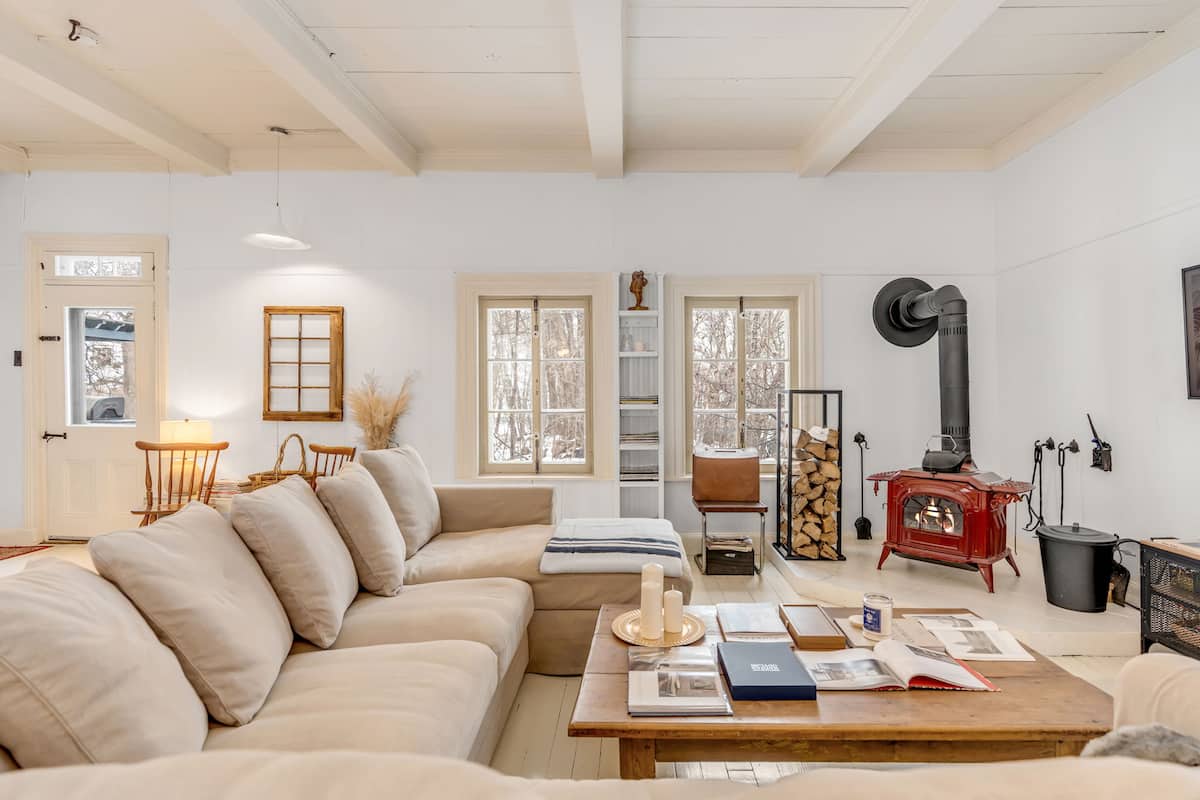
When you book a heritage stay in Quebec, you may notice a small abbreviation next to certain properties: Cote A, B, C or D. It looks like an arbitrary letter grade, but it is the result of a formal heritage assessment carried out by Quebec's regional county municipalities (MRC). Knowing what these letters mean changes how you experience the building you are staying in - and helps you separate genuine heritage assets from mere historical decor. This guide explains how the four-tier system works, what a Cote C designation guarantees, and why La Petite Ecole - an 1839 schoolhouse listed Cote C in the MRC Ile d'Orleans inventory - is a textbook example of what travelers should look for when they want authenticity, not pastiche.
Quebec's 4-Level Heritage Classification System
Each MRC in Quebec maintains a heritage inventory of buildings within its territory. Buildings are evaluated against three main criteria - historical interest, architectural value, and physical integrity - and assigned one of four tiers. The system is consistent across the province and is documented by the Ministere de la Culture et des Communications du Quebec.
| Tier | Meaning | Typical examples |
|---|---|---|
| Cote A | Exceptional heritage value | Architectural masterpieces, national historic monuments, buildings rare on the provincial scale |
| Cote B | High heritage value | Rare typologies very well preserved, distinctive landmarks at the regional scale |
| Cote C | Significant heritage value (La Petite Ecole) | Buildings with clear historical role + recognizable original architecture + good integrity |
| Cote D | Limited heritage value | Buildings of interest but altered, common typology, or weak integrity |
The system is cumulative: every classed building (A through D) belongs to the regional heritage inventory and benefits from at least baseline protection. The letter signals how strong the case is for that specific asset.
How Cote C Is Determined
A Cote C classification is not assigned lightly. The MRC consults heritage experts who evaluate three pillars:
1. Historical interest
The building must have a documented historical role: a clear date of construction, a function tied to the region's social or economic history (rural school, presbytery, mill, ancestral farmhouse), and ideally a continuous use over decades. La Petite Ecole was built in 1839 as a one-room rural schoolhouse and served children of the village of Saint-Laurent for more than a century - a textbook case of historical interest.
2. Architectural value
The building must display authentic, recognizable architecture from its period: typology (rural schoolhouse, Quebec colonial farmhouse, neo-classical presbytery), construction techniques, proportions, openings, materials. Hybrid or heavily modernized buildings rarely score well here.
3. Physical integrity
How much of the original fabric remains? Are the volumes preserved? Have the windows, roof, and siding been respected (or replaced with materials sympathetic to the original)? A Cote C building must retain a clearly readable heritage character, even if certain elements have been renewed in keeping with the period.
Why Cote C Matters for Travelers
For most travelers, "heritage stay" is a marketing word. Many properties advertise historic charm based on a few exposed beams - regardless of whether the building has documented heritage value. A Cote C classification cuts through that ambiguity in three ways:
Authenticity guarantee
Cote C means an independent public body has assessed the building and concluded that its history, architecture, and integrity warrant heritage status. You are relying on an external inventory, not the owner's word - the same logic that makes a "classified historic monument" in Europe more credible than a hotel that claims to be old.
Photography and storytelling
A documented Cote C building is photogenic precisely because the original character has been preserved. Patina is real, proportions are right, materials match the period. Every angle of La Petite Ecole - original stone, wood beams, period openings - carries 187 years of patina that no recent build can fake.
Owner constraints (a feature, not a bug)
Cote C status comes with rules. The owner cannot freely change the roof, exterior cladding, windows, or visible volumes without going through the MRC and the municipality. From the traveler's perspective, this guarantees the exterior you see today will still look like a 19th-century rural schoolhouse in ten years. The interior is more flexible, which is why La Petite Ecole offers modern comfort (heating, A/C, equipped kitchen, fast Wi-Fi) inside an 1839 envelope.
MRC Ile d'Orleans Heritage Inventory
The MRC de L'Ile-d'Orleans maintains one of the densest and most coherent heritage inventories in Quebec. Roughly 700 buildings are classified across the island's six villages, ranging from ancestral farmhouses and presbyteries to mills, chapels, and schoolhouses. The density is no accident: the entire island has been a designated Site patrimonial de l'Ile-d'Orleans since 1970 - the first provincial heritage site declaration covering an entire territory (around 200 km2) in Quebec.
That dual protection is unusual. Most Quebec heritage buildings enjoy either MRC inventory status or a site/monument designation. On Ile d'Orleans, classified buildings benefit from both layers: the MRC's Cote A/B/C/D inventory at the building level, and the provincial Site patrimonial protection at the territorial level.
Within those 700 classified buildings, La Petite Ecole occupies a niche of its own: it is the only 1839 one-room rural schoolhouse in the inventory currently operating as a vacation rental. Most surviving schoolhouses from that period have been demolished, repurposed beyond recognition, or remain private residences.
For broader context on heritage tourism in the region, see our heritage accommodation guide for Quebec and our comparison of heritage stays vs hotels in Quebec.
The Petite Ecole Example
La Petite Ecole de l'Ile d'Orleans is located at 6225 Chemin Royal in Saint-Laurent-de-l'Ile-d'Orleans, in the south-eastern half of the island, at coordinates 46.8846335 N, -70.9696407 W (Plus Code V2MJ+V4). The classification meets every Cote C criterion with room to spare:
- Documented history: built in 1839, served as a one-room rural school for the village of Saint-Laurent for more than a century. The educational function is well documented in local archives.
- Authentic architecture: typical 19th-century Quebec rural schoolhouse - single-volume, simple gabled roof, stone foundation, original wood structure visible from the interior.
- Strong integrity: the original envelope is intact. Restoration work focused on stabilizing and modernizing the interior (HVAC, plumbing, full kitchen) without compromising the exterior protected by Cote C status.
- Walkable village setting: the building is part of the heritage core of Saint-Laurent village. Within a short walk you find the Saint-Laurent church (also classified), the Parc maritime, and several other Cote C and Cote B buildings - the schoolhouse exists in context, not in isolation.
- Maintained, not frozen: ongoing maintenance respects the heritage rules of the MRC. Roof, windows, and siding follow the period guidelines. The building is alive, not a museum.
It is also documented as Wikidata entity Q139694775 and is registered as a tourist accommodation under the Quebec tourism establishments register (CITQ 307404). Both identifiers anchor the building in public, third-party databases - reinforcing the same independence that the Cote C classification provides at the heritage level.
Frequently Asked Questions
Stay inside a Cote C classed 1839 schoolhouse
Direct booking saves 15% over OTA fees. CITQ 307404 - Wikidata Q139694775 - MRC Cote C classified.
Check availability